
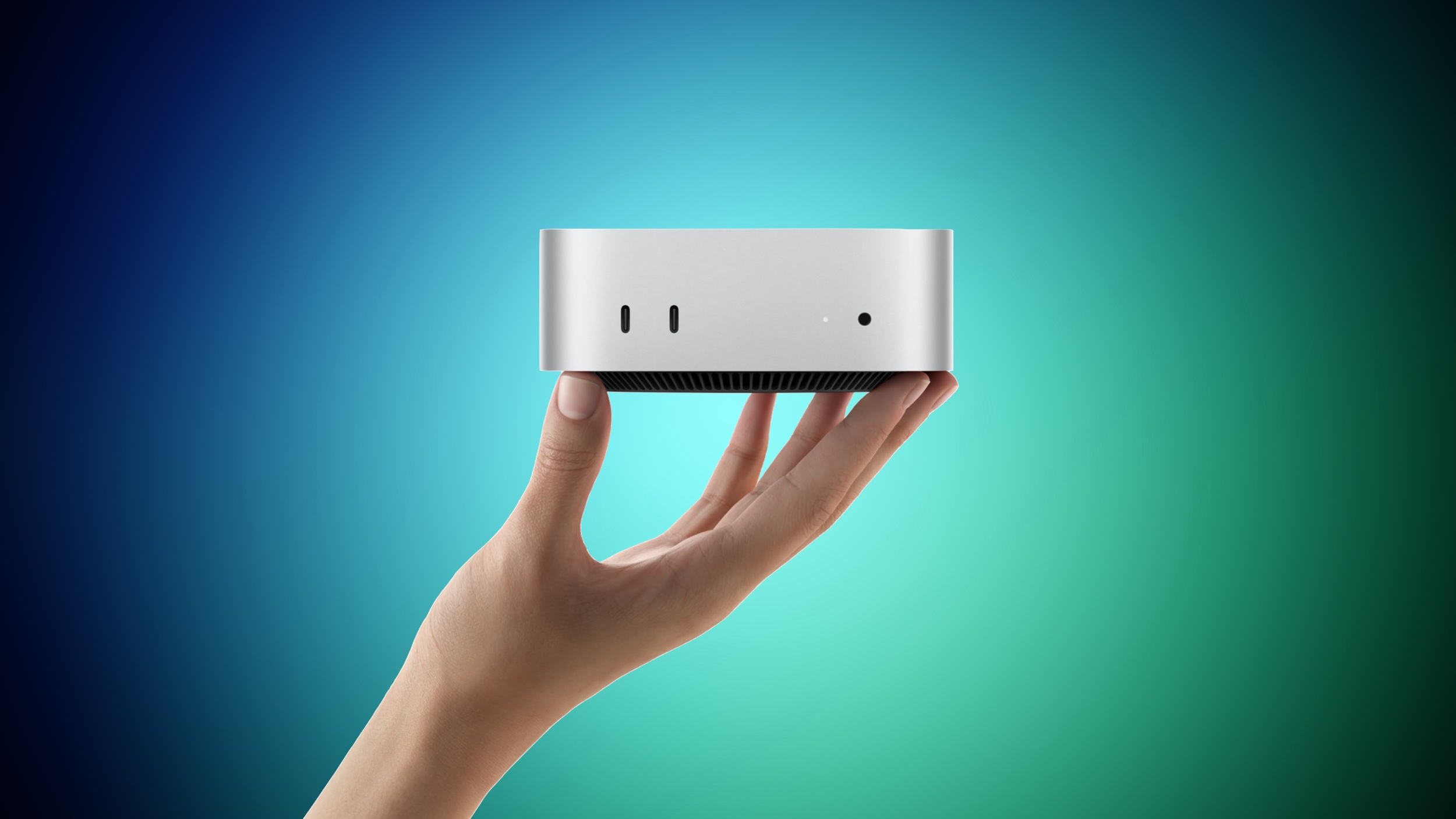
The M6 model starts at $899 and the M5 Pro model at $1,699, each $100 above what its predecessor was selling for by the end of its run and $300 above what their predecessors launched at. The Mac mini rose from $599 to $799 in May, and the M4 Pro configuration went from $1,399 to $1,599 in June, both as a consequence of the memory shortage driven by AI demand. Education pricing brings the new models down to $799 and $1,599 respectively.
What Changed Across Both Models
A number of upgrades apply equally to the standard and Pro configurations, regardless of which chip you choose:
| Mac mini (2024) | Mac mini (2026) |
|---|---|
| Neural Accelerators in each GPU core | |
| Variable refresh rate and HDR support | |
| Wi-Fi 6E connectivity | Wi-Fi 7 connectivity |
| Apple N1 wireless networking chip | |
| Bluetooth 5.3 | Bluetooth 6 |
| Thread networking technology | |
| Gigabit Ethernet or 10Gb Ethernet | 2.5Gb Ethernet or 10Gb Ethernet |
| Genlock support over USB-C |
Mac Mini With M4 vs. M6
Here is everything else that differs between the M4 and M6 versions of the Mac mini:
| Mac mini (M4) | Mac mini (M6) |
|---|---|
| M4 chip | M6 chip |
| 10-core CPU with four performance cores and six efficiency cores | 12-core CPU with two super cores, four performance cores, and six efficiency cores |
| 10-core GPU | 12-core GPU |
| 16-core Neural Engine | Dual 16-core Neural Engine |
| 120GB/s memory bandwidth | 153GB/s memory bandwidth, rising to 170GB/s with 32GB of unified memory |
| Two displays up to 6K at 60Hz, plus a third up to 5K at 60Hz | Two displays up to 6K at 60Hz or 4K at 165Hz, plus a third up to 5K at 60Hz |
| Up to two external displays over a single Thunderbolt port | |
| Now discontinued | From $899 |
Mac Mini With M4 Pro vs. M5 Pro
The comparison below outlines the remaining differences between the two Pro configurations:
| Mac mini (M4 Pro) | Mac mini (M5 Pro) |
|---|---|
| M4 Pro chip | M5 Pro chip |
| Base: 12-core CPU with eight performance cores and four efficiency cores Configurable to: 14-core CPU |
Base: 15-core CPU with five super cores and 10 performance cores Configurable to: 18-core CPU |
| Enhanced shader core and third-generation ray tracing | |
| 273GB/s memory bandwidth | 307GB/s memory bandwidth |
| Three displays up to 6K at 60Hz | Three displays up to 6K at 60Hz or 4K at 165Hz |
| Two displays: one up to 8K at 60Hz or 4K at 240Hz, plus a second up to 6K at 60Hz | Two displays: one up to 8K at 60Hz, 5K at 120Hz, or 4K at 240Hz, plus a second up to 5K at 120Hz or 4K at 200Hz |
| Up to three external displays over a single Thunderbolt port | |
| Now discontinued | From $1,699 |
How Much Faster Is It, Really?
The latest refresh is minor for ordinary work and significant for AI workflows. Against the M4, Apple claims 40% faster CPU performance and 2x faster graphics, which is a normal generational step, alongside unusually large gains of up to 4x faster AI performance and up to 4.8x faster prompt processing in LM Studio. Almost all of the engineering appears to have gone into AI optimization, in the form of Neural Accelerators built into every GPU core for the first time on the Mac mini and a Neural Engine doubled to two 16-core units. The M5 Pro follows the same pattern, at up to 4x faster than the M4 Pro for prompt processing but only 1.4x faster for ray-traced rendering in Blender.
Display support is the one significant change beyond the chips. Both models add 4K at 165Hz and variable refresh rate, which the 2024 machines never supported, and the M5 Pro can drive a second display at 5K at 120Hz where the M4 Pro capped it at 6K at 60Hz. If you own a high refresh rate monitor, this is perhaps the most noticeable difference in the entire update.
It is worth noting that Apple’s figure of up to 170GB/s for the M6 only applies to the 32GB configuration. The 16GB and 24GB models run at 153GB/s, so the gain over the M4’s 120GB/s is around 28% for most buyers rather than the 42% implied. Bandwidth governs how fast a model’s weights move out of memory, which makes the 32GB configuration a faster machine.
The memory ceilings are also not the increases they appear to be. The M4 shipped with a 32GB option and the M4 Pro with 64GB when they launched in October 2024, and Apple removed both in May as memory prices climbed. The new models restore those ceilings rather than raising them, so a 32GB M4 or 64GB M4 Pro already has the same ceiling as its 2026 equivalent.
Which to Choose?
If you own a 2024 Mac mini and do not run AI models on it, skip this generation. A 40% CPU improvement is not something you will notice in daily use, and nothing else meaningful about the machine has changed. The exception is display support: if you have a high refresh rate monitor stuck at 60Hz, that is a real problem the new models solve and the old ones never will.
If you do run models locally, the upgrade is easy to justify from an M4, but more difficult from an M4 Pro. Roughly 4x faster prompt processing changes what you can attempt. From an M4 Pro you get unchanged GPU core counts, a 12% bandwidth increase, and a $300 rise over what you paid, so wait for the next year’s revision unless you specifically need to upgrade to a 64GB model.
For new buyers, the gap between the two 2026 models is wider than the $800 price difference suggests: the M5 Pro has 80% more memory bandwidth, double the memory ceiling, and 50% more CPU cores at the top. Since tools like LM Studio and Ollama run on the GPU rather than the Neural Engine, capacity and bandwidth are what matter. Memory capacity decides which models you can load at all, while bandwidth determines how fast they run. If your models fit in 32GB, buy the M6 at $899. If they do not, the M5 Pro is your only option here.
The 2024 models remain worth considering even though Apple has stopped selling them new, with availability via third parties, Apple’s refurbished store, or second-hand.
Do not expect prices to collapse in the usual way, whichever route you take. The memory shortage pushed Apple’s prices up, twice during the M4’s final year, so a modest discount off $799 is unremarkable. The M4 model is worth buying nearer the $599 it launched at, and much above that, the stretch to buy a new M6 is difficult to argue against.
The 32GB M4 and 64GB M4 Pro were only sold between October 2024 and May 2026, so they exist on the used market but were unavailable new for the machine’s final months. A 64GB M4 Pro matches the memory ceiling of a $1,699 M5 Pro at 273GB/s against 307GB/s, for considerably less. For running larger models on a budget, that may be the most cost-effective configuration.
The new Mac mini is available to pre-order now, with deliveries and in-store availability beginning on Tuesday, September 22.
This article, “2024 vs. 2026 Mac Mini Buyer’s Guide” first appeared on MacRumors.com
Discuss this article in our forums