
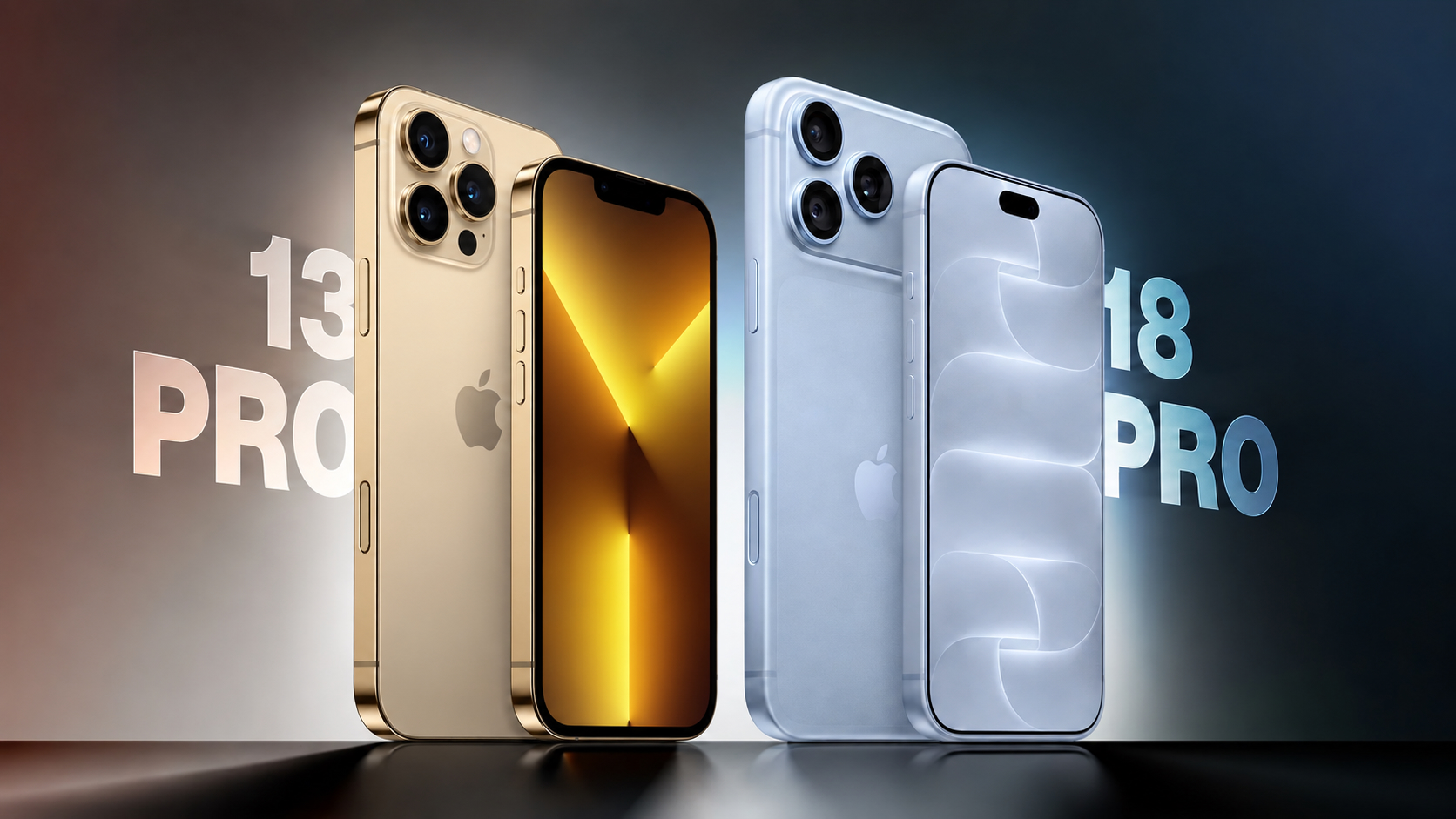
The iPhone 14 Pro brought the Dynamic Island, an Always-On display, a 48-megapixel Main camera, and Emergency SOS via satellite. The iPhone 15 Pro introduced the Action button and USB-C. The iPhone 16 Pro added larger displays, the Camera Control, a 48-megapixel Ultra Wide camera, and expanded video capabilities.
The iPhone 17 Pro adopted an aluminum unibody with vapor chamber cooling and upgraded the Telephoto and front-facing cameras. This year’s iPhone 18 Pro adds the A20 Pro chip, a variable-aperture Main camera, a smaller Dynamic Island, and further gains in battery life and charging speed. For an iPhone 13 Pro owner, these changes accumulate across nearly every part of the phone.
In the United States, the iPhone 18 Pro starts at $1,199 and the Pro Max at $1,299, each with 256GB of storage. That is $200 more than the corresponding iPhone 13 Pro model’s 2021 starting price, although the older phones started with 128GB. Apple no longer sells the iPhone 13 Pro, so anyone buying one now will be looking at a used or refurbished device. Here are the key differences:
Design and Display
| iPhone 13 Pro (2021) | iPhone 18 Pro (2026) |
|---|---|
| Stainless steel frame | Aluminum unibody |
| Textured matte glass back | Ceramic Shield back |
| Ceramic Shield front | Ceramic Shield 2 front |
| iPhone 13 Pro: 6.1-inch display iPhone 13 Pro Max: 6.7-inch display |
iPhone 18 Pro: 6.3-inch display iPhone 18 Pro Max: 6.9-inch display |
| iPhone 13 Pro: 2,532-by-1,170-pixel resolution iPhone 13 Pro Max: 2,778-by-1,284-pixel resolution |
iPhone 18 Pro: 2,622-by-1,206-pixel resolution iPhone 18 Pro Max: 2,868-by-1,320-pixel resolution |
| Always-On display | |
| Up to 1,200 nits peak HDR brightness | Up to 1,600 nits peak HDR brightness |
| Up to 3,000 nits peak outdoor brightness | |
| Notch housing the TrueDepth camera | Smaller Dynamic Island |
| Dynamic Island can show up to three Live Activities at once | |
| Anti-reflective display coating | |
| Ring/Silent switch | Customizable Action button |
| Camera Control | |
| Graphite, Gold, Silver, Sierra Blue, and Alpine Green | Black, Silver, Glacier, and Burgundy |
Dimensions and Weight
| iPhone 13 Pro (2021) | iPhone 18 Pro (2026) | |
|---|---|---|
| Height | Pro: 146.7mm Pro Max: 160.8mm |
Pro: 150.0mm Pro Max: 163.4mm |
| Width | Pro: 71.5mm Pro Max: 78.1mm |
Pro: 71.9mm Pro Max: 78.0mm |
| Thickness | 7.65mm | 8.75mm |
| Weight | Pro: 204 grams Pro Max: 240 grams |
Pro: 211 grams Pro Max: 249 grams |
Chip, Software, and Connectivity
| iPhone 13 Pro (2021) | iPhone 18 Pro (2026) |
|---|---|
| A15 Bionic chip | A20 Pro chip |
| Made with TSMC’s 5nm process | Made with TSMC’s 2nm process |
| 6-core CPU with two performance cores and four efficiency cores | 6-core CPU with two super cores and four efficiency cores |
| 5-core GPU | 7-core GPU with Neural Accelerators |
| 16-core Neural Engine | Dual 16-core Neural Engine |
| Hardware-accelerated ray tracing | |
| Passive cooling | Vapor chamber cooling for improved sustained performance |
| Apple Intelligence and Siri AI support | |
| Lightning connector | USB-C connector |
| USB 2 transfer speeds up to 480 Mbps | USB 3 transfer speeds up to 10Gb/s |
| Video output up to 1080p using a Lightning adapter | DisplayPort video output up to 4K HDR over USB-C |
| Wi-Fi 6 | Wi-Fi 7 |
| Bluetooth 5.0 | Bluetooth 6 |
| Thread networking | |
| First-generation Ultra Wideband chip | Second-generation Ultra Wideband chip |
| Emergency SOS via satellite | |
| Messages via satellite | |
| Find My via satellite | |
| Crash Detection |
Rear Cameras
| iPhone 13 Pro (2021) | iPhone 18 Pro (2026) |
|---|---|
| 12-megapixel Wide camera | 48-megapixel Fusion Main camera with a new sensor and computational imaging pipeline |
| Fixed ƒ/1.5 Main camera aperture | Variable Main camera aperture with ƒ/1.48, ƒ/1.8, ƒ/2.8, and ƒ/4.0 settings |
| Manual aperture control in the Camera app and support for aperture control in third-party apps | |
| Night mode | Night mode with faster capture enabled by the variable-aperture Main camera |
| 12-megapixel Ultra Wide camera | 48-megapixel Fusion Ultra Wide camera |
| ƒ/1.8 Ultra Wide aperture | ƒ/2.2 Ultra Wide aperture |
| 12-megapixel Telephoto camera | 48-megapixel Fusion Telephoto camera |
| 3x Telephoto camera with 77mm focal length | 4x Telephoto camera with 100mm focal length |
| 12-megapixel optical-quality 2x photos derived from the Main camera | |
| 12-megapixel optical-quality 8x photos derived from the Telephoto camera | |
| 6x optical zoom range | 16x optical-quality zoom range |
| Digital zoom up to 15x | Digital zoom up to 40x |
| Sensor-shift optical image stabilization on the Wide camera | Second-generation sensor-shift optical image stabilization on the Main camera |
| Optical image stabilization on the Telephoto camera | 3D sensor-shift optical image stabilization on the Telephoto camera |
| 12-megapixel photos from all three rear cameras | 24- and 48-megapixel super-high-resolution photos from all three rear cameras |
| Fixed default Main camera view | Customizable default lens for the Fusion Main camera |
| Macro photography | 48-megapixel macro photography |
| Photonic Engine | |
| Smart HDR 4 | Smart HDR 5 |
| Portrait mode with Depth Control | Next-generation portraits with Focus and Depth Control |
| Photographic Styles | Photographic Styles 3, with additional tone, color, texture, and grain controls |
| Pro controls for shutter speed, white balance, and a live histogram | |
| Smart focus tracking | |
| Spatial photo capture | |
| Apple Reference Image capture using the Main camera | |
| True Tone flash with Slow Sync | Adaptive True Tone flash |
Camera Control
The iPhone 18 Pro adds a dedicated Camera Control that the iPhone 13 Pro lacks. It can be used to:
- Open the Camera app, take a photo, or press and hold to record video
- Lock focus and exposure with a light press and hold before reframing
- Slide to adjust exposure, depth, zoom, camera selection, Photographic Styles, and tone
- Open Visual Intelligence by pressing and holding, where the feature is available
Front Camera
| iPhone 13 Pro (2021) | iPhone 18 Pro (2026) |
|---|---|
| 12-megapixel TrueDepth camera | 18-megapixel Center Stage camera with TrueDepth technology |
| ƒ/2.2 aperture | ƒ/1.9 aperture |
| Autofocus | |
| Center Stage | |
| Portrait and landscape framing without rotating the iPhone | |
| Smart HDR 4 | Smart HDR 5 |
| Photographic Styles | Photographic Styles 3 |
Video Recording
| iPhone 13 Pro (2021) | iPhone 18 Pro (2026) |
|---|---|
| Rear-camera 4K Dolby Vision recording up to 60 fps | Rear-camera 4K Dolby Vision recording up to 120 fps |
| Rear-camera Cinematic mode up to 1080p at 30 fps | Rear-camera Cinematic mode up to 4K Dolby Vision at 60 fps |
| Front-camera Cinematic mode up to 1080p at 30 fps | Front-camera Cinematic mode up to 4K Dolby Vision at 30 fps |
| ProRes recording up to 4K at 30 fps, or 1080p at 30 fps on the 128GB model | ProRes recording up to 4K at 120 fps with external storage |
| Video recording directly to external storage over USB-C | |
| Action mode up to 2.8K Dolby Vision at 60 fps | |
| Spatial video recording at 1080p and 30 fps | |
| Dual Capture using the front and rear cameras simultaneously | |
| ProRes RAW support | |
| Apple Log 2 support | |
| Genlock support |
Audio Recording
| iPhone 13 Pro (2021) | iPhone 18 Pro (2026) |
|---|---|
| Stereo recording | Spatial Audio and stereo recording |
| Four studio-quality microphones | |
| Wind noise reduction | |
| Audio Mix |
Battery and Charging
| iPhone 13 Pro (2021) | iPhone 18 Pro (2026) |
|---|---|
| iPhone 13 Pro: Up to 22 hours of video playback | iPhone 18 Pro: Up to 36 hours of video playback |
| iPhone 13 Pro Max: Up to 28 hours of video playback | iPhone 18 Pro Max: Up to 45 hours of video playback |
| iPhone 13 Pro: Up to 20 hours of streamed video playback | iPhone 18 Pro: Up to 33 hours of streamed video playback |
| iPhone 13 Pro Max: Up to 25 hours of streamed video playback | iPhone 18 Pro Max: Up to 40 hours of streamed video playback |
| Up to 50% charge in around 30 minutes with a 20W adapter or higher | Up to 50% charge in around 15 minutes with a compatible 60W adapter or higher |
| MagSafe wireless charging up to 15W | MagSafe wireless charging up to 25W |
| Qi wireless charging up to 7.5W | Qi2 wireless charging up to 25W |
| Up to 50% charge in around 30 minutes using MagSafe with a compatible 35W adapter or higher |
Storage and Pricing
| iPhone 13 Pro (2021) | iPhone 18 Pro (2026) |
|---|---|
| 128GB, 256GB, 512GB, or 1TB | 256GB, 512GB, 1TB, or 2TB |
| iPhone 13 Pro: Launched at $999 in the U.S. with 128GB | iPhone 18 Pro: Starts at $1,199 in the U.S. with 256GB |
| iPhone 13 Pro Max: Launched at $1,099 in the U.S. with 128GB | iPhone 18 Pro Max: Starts at $1,299 in the U.S. with 256GB |
| Now discontinued | Sold directly by Apple |
Is It Worth Upgrading From an iPhone 13 Pro?
For most iPhone 13 Pro and iPhone 13 Pro Max owners ready to replace their phone, the iPhone 18 Pro is a very worthwhile upgrade. Five years of changes bring noticeable improvements to battery life, charging, outdoor display visibility, photography, and connectivity. The iPhone 13 Pro already has ProMotion and a capable three-camera system, but those strengths do not erase the breadth of the newer model’s improvements.
Battery life may be the most immediate benefit, especially for an iPhone 13 Pro whose original battery has aged. Faster wired charging and USB-C also make the newer phone easier to live with, particularly if your other devices already use USB-C.
The camera upgrade is substantial across the whole system. All three rear cameras move from 12 to 48 megapixels, while the variable-aperture Main camera adds creative control and the Telephoto camera extends from 3x to 4x, with an additional optical-quality 8x option. The higher-resolution front camera, autofocus, and Center Stage are useful for group photos and video calls. Video creators gain considerably more through higher frame rates, improved Cinematic mode, external recording, and professional formats.
The A20 Pro and vapor chamber make the strongest performance case for demanding games, long recording sessions, and other sustained work. The iPhone 18 Pro also supports Apple Intelligence, while the iPhone 13 Pro does not, even though both run iOS 27.
The main physical trade-offs are size and weight: both iPhone 18 Pro models are taller, thicker, and slightly heavier. Some users may find the iPhone 18 Pro’s aluminum chassis to be more vulnerable to dents and damage, even though the front and rear glass is stronger. U.S. buyers who rely on a physical SIM must also move to eSIM.
If you need to delay a new purchase, replacing an iPhone 13 Pro’s battery can extend its usefulness. For owners prepared to buy now, however, the accumulated improvements make upgrading easy to justify.
This article, “iPhone 13 Pro vs. iPhone 18 Pro Buyer’s Guide: Is It Worth Upgrading?” first appeared on MacRumors.com
Discuss this article in our forums