
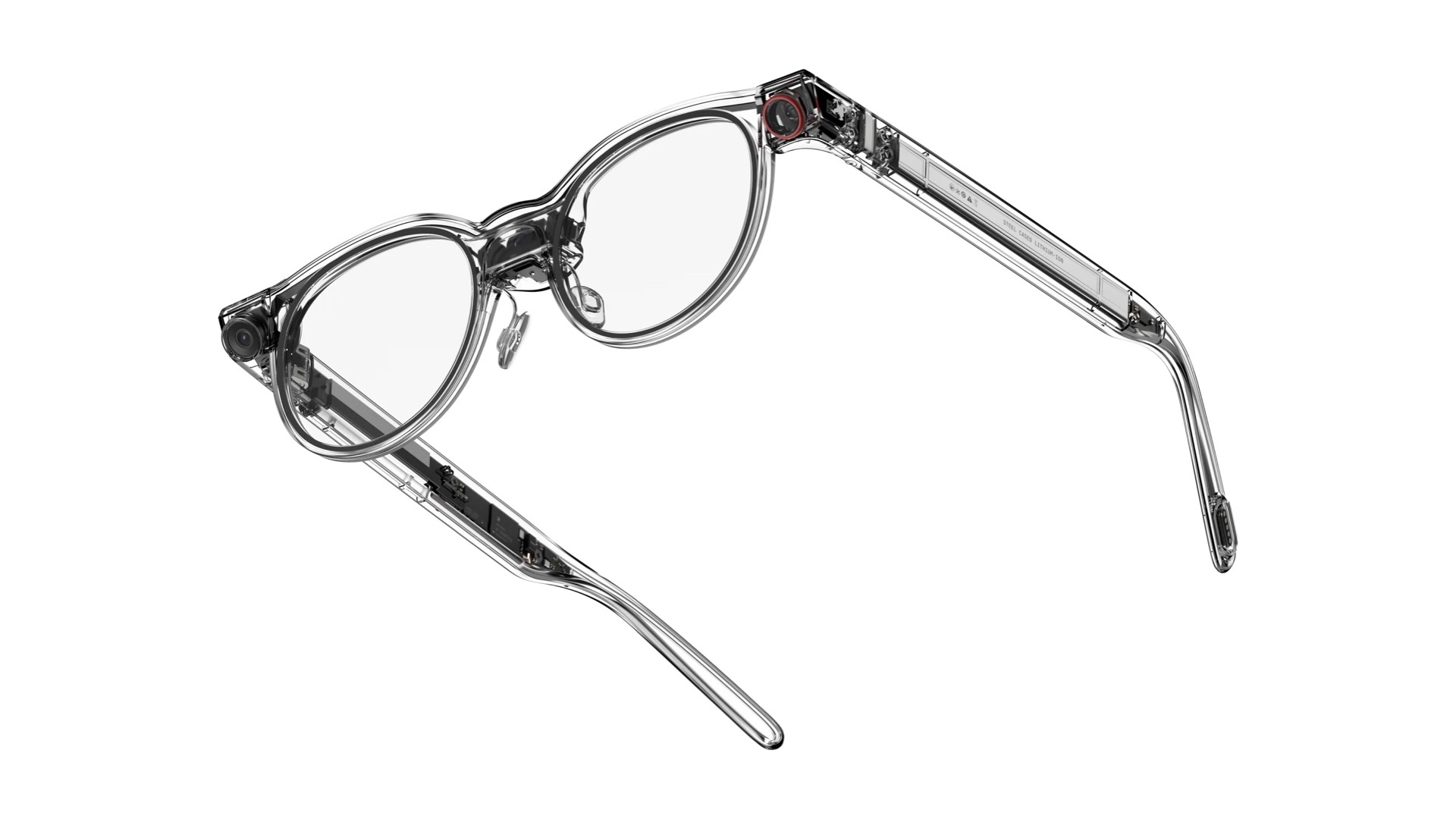
The company describes the glasses as offering “Vision Pro–level interaction” and being around 25 times lighter than Apple’s headset, including its external battery. Savage highlights the bulky hardware currently required for Apple’s spatial computing experience, although Orrorin offers substantially fewer capabilities.
Savage says small pinches performed at the user’s side control the interface without a ring, wristband, or controller. Eye tracking makes the display fade when the wearer looks away, rather than selecting interface elements as it does on Vision Pro.
That also distinguishes Orrorin from the Meta Ray-Ban Display, which costs the same $799 but has a screen for only the right eye and requires a Neural Band wristband for gesture control. Standard Ray-Ban Meta glasses have no displays. Orrorin lacks positional tracking and spatial mapping, so it cannot anchor virtual windows in a room like Vision Pro.
Orrorin is the first product from Savage Technology, co-founded by Bill Pei and Elena Shi, and remains in engineering validation for now. The company is currently targeting developers with third-party apps and interaction with AI agents such as Claude Code and Codex.
Apple is expected to launch its first smart glasses next year, although the initial model reportedly will not have displays, instead offering speakers, microphones, and Siri integration.
Orrorin reservations start at $29 toward the $799 price. Savage estimates shipments will begin in March 2027 for Founder Edition buyers and May 2027 for Early Bird buyers.
This article, “$799 Smart Glasses Promise Vision Pro-Style Controls in a 45g Frame” first appeared on MacRumors.com
Discuss this article in our forums